

 Contributed by Jared S. Saterfiel, District Manager, PPM Consultants
Standing on the edge of a sandstone cliff just outside Moab, Utah, it’s hard not to feel small. Layer after layer of rock stretches out in front of you—each one a record of time, pressure, and change. What looks permanent at first glance is anything but. The landscape itself is the result of millions of years of erosion, where wind, water, and temperature slowly reshape even the hardest formations. And if you spend enough time out there, one realization starts to take hold: what you’re looking at isn’t just geology, it’s a process. One that feels surprisingly familiar.
A Landscape Built on Change
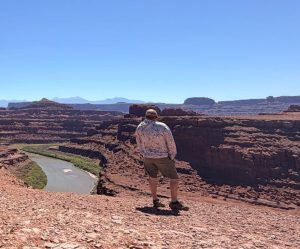 The sandstone formations around Moab weren’t created overnight. They were built over time as sediments were deposited, compressed, and hardened into rock. Later, uplift exposed those layers, and erosion began its work—carving canyons, breaking down weaker materials, and revealing what lies underneath. Even today, that process continues. Rivers, storms, and temperature swings steadily wear down the landscape. Some layers resist longer than others, but eventually, everything is reshaped or removed. What remains is not a static monument; it’s a constantly evolving system.
Policy Isn’t All That Different
Environmental policy in the United States has followed a remarkably similar path. Over decades, layers of regulation have been built through legislation, agency rulemaking, and court decisions—especially since the rise of modern environmental law in the 1970s. But like the sandstone formations in Moab, those layers have never remained untouched. Environmental policy in the U.S. often swings between administrations, defined by a tug-of-war between aggressive mitigation efforts and economic deregulation. These shifts shape everything from the design of modern vehicles to how ecosystems are protected at the local level.
Each administration leaves its mark. Some add new layers tightening standards, increasing oversight, or expanding regulatory authority. Others strip those layers back, reducing requirements, shifting authority, or reinterpreting the legal foundation behind prior rules.
Over time, those layers don’t just disappear—they leave behind fragments. Much like the boulders scattered across the desert floor, past administrations leave behind pieces of policy that no longer serve as primary structure but still influence the landscape. Some rules linger in partial form. Others are reworked into new frameworks.
These fragments matter. They create friction, redirect momentum, and sometimes form the foundation for what comes next. In that way, environmental policy is not just built and eroded; it is accumulated, broken apart, and reassembled over time. What we operate within today is not a clean slate, but a terrain defined by both what has been constructed and what has been left behind.
A Recent Example of Policy ‘Erosion’
One of the clearest examples of this cycle is the role of the EPA’s 2009 Endangerment Finding. That finding established that greenhouse gases could be regulated under the Clean Air Act, serving as the legal foundation for a wide range of emissions standards across multiple sectors. If you’ve followed recent regulatory discussions—like Will DEF Be Deleted? EPA’s July 2025 Proposal — A Pivotal Moment for Vehicle Emissions Policy—you can see how deeply those foundational determinations influence downstream compliance decisions and industry expectations.
We saw similar ripple effects in more targeted policy decisions, such as the EPA Auto Start-Stop Decision, where regulatory intent and practical implementation didn’t always move in a straight line.
Regardless of where someone stands on the policy itself, the takeaway is clear: what was once considered foundational can be reinterpreted, removed, or replaced—just like a softer sediment layer exposed to the elements.
Build, Break Down, Repeat
This isn’t new—it’s inherent to how environmental policy has always evolved. Recent administrations highlight just how sharply those shifts can occur. One approach emphasizes deregulation and domestic energy production, while another prioritizes emissions reductions and clean energy investment. Within specific policy areas—vehicle standards, public land use, environmental justice, and chemical regulation—the contrasts are clear. But these shifts are part of a longer arc that stretches back to foundational legislation in the 1970s and continues through modern climate policy.
Much like erosion in Moab, the process is uneven. Some changes happen slowly over time. Others happen quickly—like a flash flood cutting a new channel through the landscape. But the broader pattern remains: nothing stays exactly as it was.
What It Means Moving Forward
Walking through Moab, you start to understand that erosion isn’t destruction—it’s transformation. It reveals structure. It exposes weaknesses. It reshapes the surface, but it also helps define what remains. Environmental policy works in much the same way. Each administration tests the strength of what came before—sometimes reinforcing it, sometimes pulling it apart. Over time, what survives tends to be what can adapt, withstand scrutiny, and evolve alongside changing priorities. That doesn’t mean the system is broken—it means it’s alive.
Final Thought
Out in the desert, the cliffs will keep changing long after we leave. The layers will continue to shift, break, and reveal new shapes. Environmental policy will do the same. And maybe the better question isn’t whether the system is building or eroding—but whether, over time, it’s forming something stronger beneath the surface.
At PPM Consultants, we’re committed to helping our clients navigate this evolving landscape with clarity, compliance, and care. If you would like to discuss, please feel free to contact me at Jared.Saterfiel@ppmco.com or (318) 812-3470.
If you’d like to see more articles like this on a weekly basis, consider subscribing to the PPM Environmental Journal. Click HERE to subscribe.