

 Contributed by Todd Perry, CEO, PPM Consultants
A Sleeping Giant of Global Energy
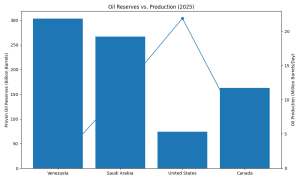
Venezuela holds the largest proven oil reserves in the world, estimated at more than 300 billion barrels, surpassing even Saudi Arabia. Most of this oil is concentrated in the Orinoco Belt, a vast petroleum-bearing region spanning eastern Venezuela along the Orinoco River basin. The belt contains enormous deposits of extra-heavy crude trapped in shallow, laterally extensive reservoirs, making the resource geologically abundant but technically challenging. This oil is highly viscous, carbon-intensive, and requires significant upgrading and the use of diluents before it can be transported and refined into usable products.
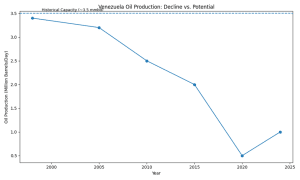
Despite this enormous endowment, Venezuela’s oil wealth has remained largely unrealized. Political instability, economic collapse, U.S. sanctions, and prolonged mismanagement of PDVSA, the state-run oil company, have driven production sharply downward. Output has fallen from roughly 3.5 million barrels per day in the late 1990s to well under one million barrels per day today, leaving vast reserves stranded underground.
As global energy demand continues to rise and supply chains remain under pressure, Venezuela’s oil is once again emerging as a geopolitical and environmental wildcard—one with implications that extend far beyond its borders.
Strategic and Economic Implications
- Global Oil Markets
If Venezuela were able to restore even a portion of its former production capacity, the impact on global oil markets would be significant. The country’s idle capacity alone could rival the total production of major exporters such as Nigeria or Angola. Even modest increases in output could help stabilize supply in an increasingly tight global market.
- U.S. Energy Security
Although the United States imports less Venezuelan oil today than it did prior to 2019, Gulf Coast refineries remain uniquely equipped to process heavy crude. Restoring limited commercial flows—under clearly defined conditions—could reduce U.S. reliance on less stable or adversarial suppliers while improving hemispheric energy resilience.
- China and Russia Influence
Absent Western engagement, Venezuela’s energy sector risks falling further under the influence of China and Russia, both of which have already invested heavily in its oil infrastructure and sovereign debt. A pragmatic, conditional re-engagement by Western democracies could help rebalance strategic influence in the region while reinforcing higher standards of transparency and accountability.
Environmental Risks: What Happens If Venezuela Ramps Up?
An unregulated or poorly supervised expansion of Venezuela’s oil sector carries substantial environmental risks, including:
- Deforestation and land degradation in the Orinoco Belt
- Elevated flaring and methane emissions from aging infrastructure
- Water contamination tied to outdated production and refining practices
- Carbon intensity that can be twice that of conventional light crude, such as Saudi grades
Unchecked development could accelerate emissions and ecological harm in a sensitive region. At the same time, disengagement carries its own risk: production that proceeds under partnerships with fewer environmental safeguards, weaker oversight, and minimal transparency.
The Uplift Potential: Energy as a Path to National Recovery
Venezuela’s oil reserves are more than a geopolitical asset—they represent a potential lifeline for national recovery. If developed responsibly, energy production could provide the foundation for economic stabilization in a country grappling with hyperinflation, food insecurity, and large-scale emigration.
Key opportunities include:
- Revenue for Essential Services
With transparent governance—such as independent oversight or a sovereign wealth structure—oil revenues could help rebuild health care systems, education, and critical infrastructure. - Employment and Human Capital
Revitalizing the energy sector could create jobs for hundreds of thousands of Venezuelans, helping restore technical expertise and reverse the loss of skilled labor. - Market Incentives for Governance Reform
Tying investment and access to technology to anti-corruption measures, property rights, and judicial integrity could support broader institutional reform rather than reinforce extractive mismanagement. - Western Leverage over Authoritarian Influence
Responsible engagement provides the U.S. and its allies a means to counterbalance Chinese and Russian influence while promoting higher governance and environmental standards. - Responsible Production and Carbon Accountability
With the right conditions, Venezuela’s oil development could meet EPA-level environmental practices, including methane reduction, land restoration, and verifiable carbon mitigation strategies.
A Common-Sense Environmental Policy Framework
Rather than forcing a choice between energy realism and environmental stewardship, the United States should pursue a pragmatic policy framework—one aligned with market-based innovation, national security, and federalism.
Key elements include:
- Conditional Engagement and Technical Oversight
Permit U.S. company participation only under strict performance, monitoring, and reporting requirements consistent with modern environmental standards. - Carbon Transparency
Establish a carbon intensity index for imported crude, allowing policymakers and refiners to evaluate barrels not just on price, but on environmental footprint. - Permitting Reform at Home
Accelerate domestic energy infrastructure approvals—particularly for LNG, pipelines, and cleaner crude—by modernizing NEPA reviews and reducing permitting timelines. - Strategic Petroleum Reserve Rebuilding
Use any temporary Venezuelan imports to replenish the Strategic Petroleum Reserve rather than deepen long-term dependency. - Energy Diplomacy with Guardrails
Align energy engagement with enforceable standards for transparency, human rights, and emissions performance, similar to existing anti-corruption frameworks.
Closing Thoughts
Venezuela’s oil is not going away. The more important question is who will shape how—and under what standards—it is developed.
A smart, conservative environmental approach does not mean abandoning fossil fuels or enabling bad actors. It means setting clear expectations, demanding accountability, and applying American expertise to achieve cleaner, safer outcomes.
The opportunity for leadership is real. But leadership requires more than ideology—it demands common sense, discipline, and the willingness to shape the future before others do it for us.