

 Contributed by Jared S. Saterfiel, District Manager, PPM Consultants
There is a point during deer season when you realize you aren’t really hunting deer anymore. You’re hunting patterns. You start paying attention to things most people would probably walk right past: a trail cutting through a strip of thick cover, fresh tracks along the edge of a creek, the direction of the wind, a rub on a tree that wasn’t there a few days ago, or acorns beginning to fall in one area while a food plot sits almost untouched somewhere else.
Individually, none of those observations tell you very much. Put them together and the landscape starts telling you a story.
After spending enough time hunting and managing property, particularly the same piece of ground year after year, you begin looking at land differently. What once looked like woods becomes a collection of interconnected systems: food, water, terrain, cover, weather, pressure, and movement.
The more I have thought about it, the more I have realized that environmental consulting really isn’t all that different.
The Answer Isn’t Always Where You’re Looking
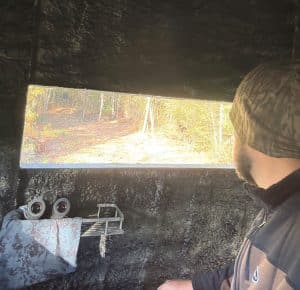 One of the easiest mistakes in hunting is assuming that because something looks good on a map, deer should be there.
You can plant a great food plot and have very little daylight activity. The food may not be the problem at all. Maybe the wind is wrong. Maybe there isn’t enough cover nearby. Maybe you’re disturbing the area every time you enter it. Or maybe the deer have simply found a better combination of food, water, and security somewhere else.
Finding the answer means stepping back.
Environmental investigations often require the same approach.
A laboratory result is important, but it represents one sample collected from one location at one point in time. To understand what is actually happening at a site, environmental professionals have to consider that result alongside the site’s history, geology, groundwater conditions, drainage, structures, previous operations, and other available information.
Sometimes the most important question isn’t, “What was the result?” It is, “Why are we seeing this result here?”
That distinction can change the way you look at the entire site.
A Data Point Isn’t a Pattern
Trail cameras have changed deer hunting in an interesting way. They can provide an incredible amount of information, but they can also provide a false sense of certainty.
One picture tells you a deer was standing in a particular place at a particular time. That’s it. It doesn’t necessarily tell you where that deer came from, where it went afterward, or whether it will ever follow the same path again but collect observations over time and something different begins to happen. Patterns emerge.
You begin seeing which areas are consistently being used, how movement changes with conditions, and where activity increases or disappears.
Environmental data works much the same way.
Whether we are looking at groundwater, soil, or another environmental condition, individual results are important but understanding how those results relate to one another can be even more valuable.
A series of observations begins to provide context. What initially looked random may reveal a trend. What appeared significant in isolation may become less important when viewed as part of the larger site.
The numbers matter. But so does understanding the pattern behind them.
Learning What Deserves a Second Look
There is another part of hunting that is difficult to explain until you have spent a lot of time outdoors.
Two people can walk through exactly the same woods and see completely different things. One person sees trees, brush, and a creek. Someone who has hunted for years might notice a faint trail crossing the creek, tracks pressed into the bank, a freshly rubbed sapling, an opening in the thick cover, and the subtle transition between two types of habitats.
The landscape didn’t change. The difference is experience.
Environmental professionals develop a similar eye.
After visiting numerous industrial facilities, petroleum sites, and other properties, you begin noticing things that deserve another question. Why does the ground slope in that direction? Where would runoff naturally travel? What used to be located here? Why are the results different in this particular area? Does what we are seeing in the field match what the historical records suggest should be happening?
None of those observations necessarily provides the answer by itself. More often, they tell you where to look next, and that can be just as valuable.
Conditions Change
Anyone who hunts the same property long enough also learns that last year’s strategy may not be this year’s answer.
Timber gets cut. Vegetation grows back. Food sources change. Water levels rise and fall. Weather patterns shift. Neighboring properties change. An area that produced consistent activity for years can suddenly go quiet.
The temptation is to keep doing what worked before. Eventually though, the evidence forces you to reevaluate things.
Environmental sites evolve too.
Conditions observed years ago may not perfectly represent conditions today. Additional information can change our understanding of a site. Data from a new investigation can confirm an old assumption or challenge it.
Maybe better to say, in consulting you must be willing to modify your solution or viewpoint as new, more telling data becomes available. Experience is valuable because it gives us somewhere to start. Data tells us whether we should stay there.
Sometimes You Need to Step Back
Perhaps the biggest similarity between hunting and environmental work is that neither rewards tunnel vision.
When something doesn’t make sense, staring harder at the same piece of information usually isn’t the answer. Sometimes you have to back up and reevaluate the geology. Take a fresh look at what surrounds the site. Consider how water moves through the subsurface. Compare today’s observations with historical data. Then start reconnecting all the pieces.
Hunting has taught me that understanding a piece of property isn’t necessarily about collecting the most information. It is about recognizing which details matter and understanding how they fit together.
Environmental consulting is much the same.
Laboratories give us analytical results. Maps give us locations. Monitoring points give us observations. Historical records help tell us what happened before we arrived. Field personnel provide another layer of information through what they see firsthand. But none of those pieces exists independently.
The real value comes from putting them together and developing an understanding of what the site is telling us. Sometimes that requires sophisticated investigation and analysis. And sometimes it starts with something much simpler:
Slow down. Look around. Learn to read the land.
At PPM Consultants, we help clients understand environmental conditions by combining field observations, technical data, and practical experience. If you would like to discuss, please feel free to contact me at Jared.Saterfiel@ppmco.com or (318) 812-3470.
If you’d like to see more articles like this on a weekly basis, consider subscribing to the PPM Environmental Journal. Click HERE to subscribe.